Personalised learning
Adapts content and pace to each student's level.
How artificial intelligence is changing teaching and learning, and what it means for students, teachers and schools in India.
Artificial intelligence is moving into classrooms quickly. Used well, it can support teachers and help students learn. Used carelessly, it brings real risks. This page gives a clear, balanced view of AI in education, and how to make the most of it safely.
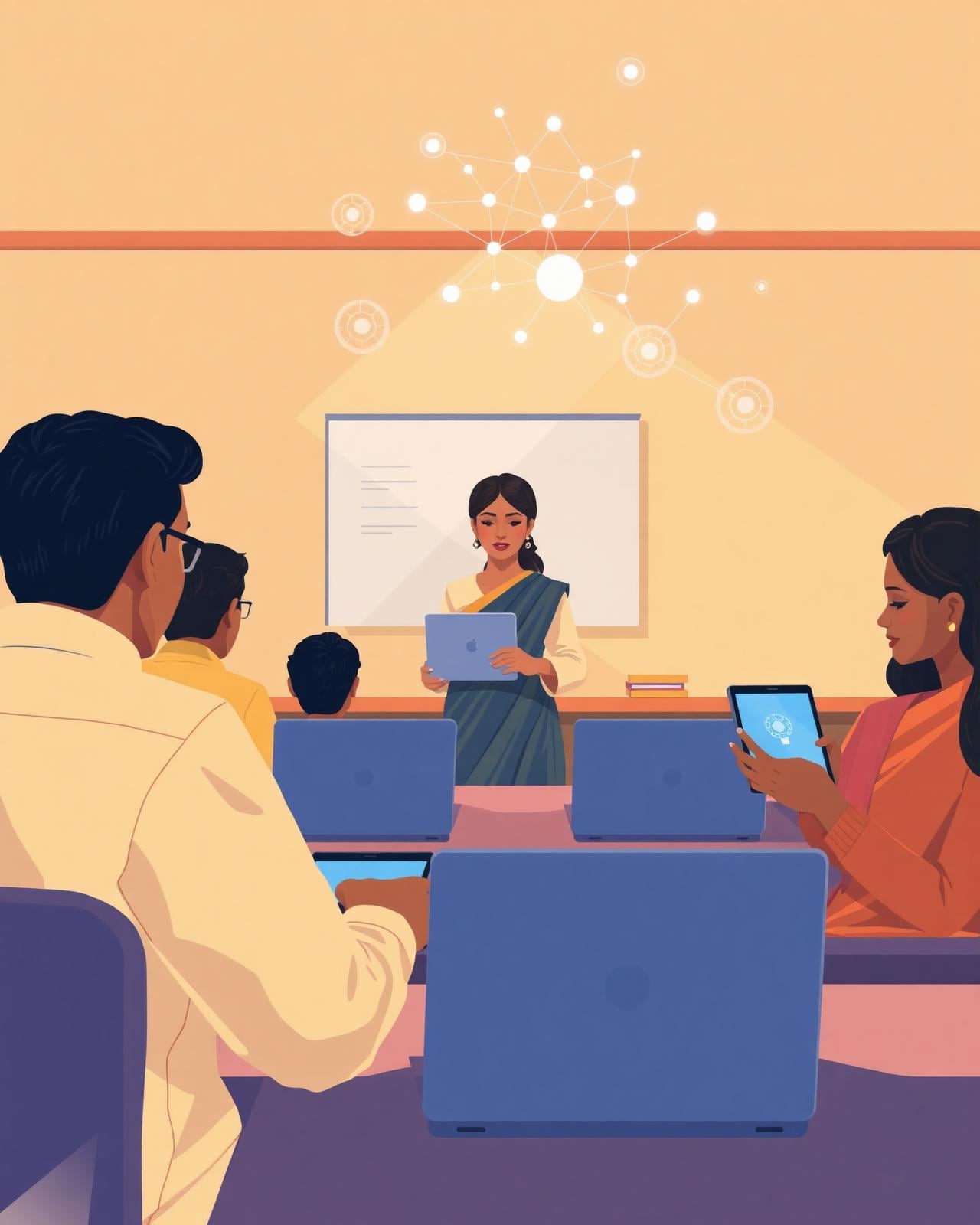
AI in education means using artificial intelligence to support teaching, learning and school administration. This includes tools that adapt lessons to each student, help teachers plan and grade, answer student questions, translate content, and analyse progress.
The goal is to support good teaching, not replace it.
Adapts content and pace to each student's level.
Gives instant help, hints and feedback as students work.
Helps create lesson plans, worksheets, quizzes and rubrics.
Text-to-speech, translation and support for diverse learners.
Assists with scheduling, records and progress analytics.
Generates summaries, examples and practice questions.
that meets students where they are.
on routine planning and marking.
through translation, read-aloud and inclusive tools.
so students improve sooner.
that help teachers spot who needs more help.
AI in education is not without risks, and an honest view matters:
AI can be wrong or biased, so outputs always need a human check.
Student data and privacy must be protected carefully.
Over-reliance can weaken critical thinking if AI is used as a shortcut.
Academic honesty needs clear rules so AI supports learning, not cheating.
The digital divide can widen gaps if access is uneven.
Teachers need training and clear guidelines to use AI well.
Under NEP 2020 and NCF-SE 2023, AI and computational thinking are being introduced in schools from Class 3, starting in 2026 to 27. CBSE already offers AI as a subject (codes 417 and 843), and national efforts support teacher training and AI readiness. The clear direction is AI for All.
Getting AI in education right starts with people, not tools. When students and teachers understand how AI works and how to use it responsibly, the benefits grow and the risks shrink.
That understanding is called AI literacy, and it is what HAILM is built to deliver.
HAILM aligns AI in education with NEP 2020 and NCF-SE 2023, and supports teachers with practical, classroom-ready training.
It is the use of artificial intelligence to help with teaching, learning and running schools.
Personalised learning tools, AI tutors, lesson-planning and grading helpers, translation and read-aloud tools, and progress analytics.
Personalised support, time saved for teachers, wider access, and faster feedback for students.
Wrong or biased outputs, privacy concerns, over-reliance, academic honesty issues, and unequal access.
Under NEP 2020, AI is being introduced from Class 3, with CBSE offering AI as a subject and national support for teacher training.
HAILM helps students and teachers use AI safely and confidently, with a structured program built for India.